
Jovan Jovanović Zmaj:

Jovan Jovanović Zmaj:
With all the hurly-burly of finishing The Book and my subsequent visit to an Alpine sanatorium, I forgot to mention that the wife and I had a chance to go to Obecní Dům (Prague’s Municipal House) for a friend’s upscale birthday celebration two weeks ago. Obecní Dům is one of the architectural landmarks of Czech’s brief one-of-the-ten-richest-countries-in-the-world phase between the wars: Art Noveau masterpiece, houses works by Alfons Mucha, blah blah blah…

Going to a private party in Obecní Dům is one of those things that simultaneously feels highly pretentious but also undeniably gratifying in that you can really sense that guys in top hats were legitimately doing the same thing 90 years ago, presumably arriving via hydrofoil and lighting cigars on fire with thousand crown notes and whatnot. Basically, it’s one of those things like Bourbon and Branch in SF where people are willing to pay a bunch of money to experience a convincingly retro atmosphere, except in this case the retro atmosphere actually has some real historical legitimacy and isn’t just a made-up bogus embarrassment.
Going to Obecní Dům for the first time was significant because we’ve actually had a piece of the building’s facade living with us in our apartment, although I didn’t know it for a long time. When we moved in, this giant cement baby head was mysteriously hanging from a beam:
Being generally afraid of babies, I tried to avoid direct eye contact with the thing and came downstairs every morning hoping it would be gone in the same mysterious fashion that it disappeared. Eventually resigned to its presence, I took advantage of the landlord showing up at one of our parties to ask him where it had come from in the first place. He – a retired architect – replied that he was working on a face-lift of Obecni Dum at some point in the 80s and somehow came into possession of a leftover cherub from the building’s exterior.
A note about our landlord: he – a semi-retired architect– and his wife are in their late 60s or early 70s and live right below us and seem to have stepped out of one of those Merchant Ivory films that soft-peddle genteel visions of Europe to American audiences. If I were ever casting a movie that required a cultured, likable elderly Czech couple, I would immediately call them.
I also thought to ask him about who had lived in our flat before us, since it’s a very idiosyncratic attic flat that one can only imagine a childless couple inhabiting. This led to the following exchange:
Landlord: ‘Oh, they were a very nice couple. Much like you, in fact: the woman was Czech and the man was an American. And they also liked traveling quite a bit.’
Me: [imagining exact duplicates of us; starting to get a bit creeped out].
Landlord: (after a pause) Except they were quite old. Older than us!
Me: [radically recalibrating mental image, as my landlord is about 70s years old]
So, there seems to be sort of a Benjamin Button dynamic happening with our place. No doubt caused by the magical concrete cherub.
I think I’ve now written down everything I had to say when I started this blog nearly three years ago. My gratitude to everyone who’s read along over the years, and especially to those who have chimed in with comments. So long, and thanks for all the fish.
See also: The First Post
I enjoyed this stirring re-enactment of the events of November 10, 1989:
Notice how there’s a Hasselhoff-ian figure atop the mobile platform thing, and how lights start going on and off as he performs once the Wall falls. Nice touch. This atones for the minor historical inaccuracy my wife pointed out: that the Wall actually falls from the West into the East in this little drama.
I have a problem with being a poor sport. This extend both to sports that I actually play and to spectator sports. The Superbowl this past Sunday was certainly no exception— in fact, it was pretty much the opposite of an exception. I watched it at my place with one friend who complained that I alternated between bouts of ‘passive aggressive’ (his formulation) gloom and insufferable smugness, and left during halftime. Before he left, I tried pointing out that my behavior couldn’t really be described as ‘passive aggressive’, since that would mean that it was somehow aimed at him, to get a rise or inflict suffering— and the truth is that I was far too grimly preoccupied by the game to give a damn about him. His response: ‘Well, I guess when it comes to passive aggression, it’s all in the eye of the beholder’— which makes some sense, I have to admit.
This left me with one guest for the second half, which was probably one too many. Somehow, I’d always assumed that sports would mean less and less to me as I got older, but in fact, the exact opposite has happened— the weekend leading up to the Superbowl, I had two different dreams about the Patriots losing. This lucky soul who got to watch the game with me was a guy— a perfectly kind guy, really— whom I’d only met for five minutes the day before, but extended a invitation to join him once I ascertained that (a) despite being from New York, he wasn’t a partisan Giants fan and (b) he had no other plans and was planning to watch the game by himself at a bar otherwise.
Fast forward two-and-a-half hours and it’s 4am and I’m slumped on the sofa like I’ve been shot, reeling from a catastrophic last-minute loss, reeking of alcohol and bitterness. My guest is standing nervously by the door, trying to make bland, soothing conversational offerings. Gradually, it becomes apparent that the SBahn back to his place doesn’t leave for another 40 minutes. Swallowing hard, I’m able to resist my impulse to kick him out of my house (just out of raw, malign scapegoating— not like he’d done anything wrong) and halfway pull myself together to make acceptable conversation (we both lived in Prague, our wives are friends, our kids may end of at the same kindergarten) until he’s able to make his escape.
Incredibly, this is the second year I’ve wound up in this predicament. Last year, I watched the disheartening end of the 2010-11 Patriots season in a sports bar in Prague, where I noticed my neighbor sitting behind me and make a desperate attempt to sneak out without him after the terrible end. Once he foiled my escape and made it apparent that we would be taking the late night tram home together, I tried to shake him by announcing that I ‘actually really just feel like making the trip home on foot’ … at which point, he declared that he too felt like doing walking home. So, this was even worse: same grizzly requirement of prolonged small talk, but this was outdoors and in the cold in January at 3 or 4am.
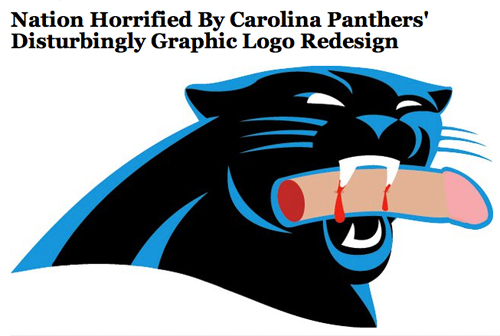
Image: from the Onion, of course.
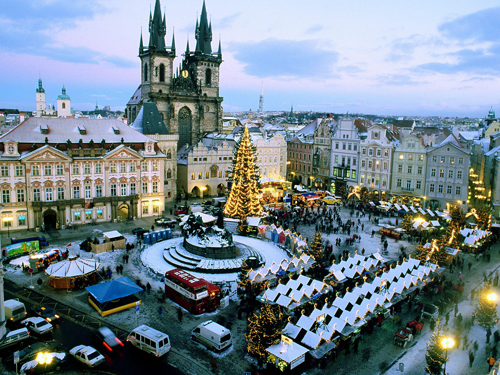
Have you agreed to spend Christmas in the Czech Republic next year? Worried about what to wear, or whether it’s in fact a Christian country? Here are answers to frequently asked questions about how the holidays are celebrated by these strange and mysterious people…
When Is Czech Christmas?
December 24th.
And that doesn’t mean that they really celebrate it on the 25th and just open presents on Christmas Eve, like some weirdo families in the U.S. It really means that the 25th is just another ordinary day, the night of the 23rd has special ‘Xmas eve’ status, etc.
Do Czechs believe in Santa Claus?
No. At least, not as the bringer of gifts. In the Czech Republic, presents are delivered by ‘Baby Jesus’ (Ježišek).
Santa is reserved for a lesser holiday called Mikulaš, when adults (read: drunk friends of one’s father) dress up as either Santa or the devil and caper about for the benefit of children.
So how does Baby Jesus make and deliver presents? Does he have a North Pole workshop and team of reindeer?
No. It remains unexplained how exactly the presents get into the house— somehow, they just materialize.
Does Baby Jesus even have a agreed-upon physical form that can be leveraged for Christmas marketing?
Visualizations of Ježišek have begun to pop up in order to combat the increasing infiltration of Santa into Czech culture (this is actually a phenomenon that Czechs perceive and mildly resent). Yet the cartoon representations that I find on the internet are so kitschy, I can’t bring myself to post them.
Is traffic bad during Czech Christmas?
Only if Vaclav freaking Havel decides to die right before the big day and clot up the entire city for his public funeral. Nice timing, hippie.
What about food? What do Czechs like to eat on Christmas?
Carp. Which is weird, given that the fish are generally marginalized in the country’s culinary habits during the rest of the year. This leads to the second-coolest phenomenon associated with the Czech holidays: carpmongers! In the weeks leading up to Christmas, there are guys standing on street corners with bathtubs filled with squirming carp.
What’s the first-coolest phenomenon associated with the Czech holidays?
Readily-available hot wine purchased from street vendors.
Do Czechs hate Christmas?
No, not at all!
What activities can I expect to encounter on Czech Christmas?
Basically, tons of eating and brain-deadening dosages of pohádky (searingly cheesy TV fairytales about princesses and horses and goblins and whatnot).
I’m in the Czech Republic and have friends coming to visit from abroad over the holidays. Are there any ready-made practical jokes I can play on them?
Wait until your friends have bought their tickets and then inform them that the entirety of December is spent celebrating something called ‘The Feast of St. Wenceslas’, during which there is no alcohol sold or consumed whatsoever. Then, pretend to ‘lighten their spirits’ by claiming that, despite this prohibition, the city is tons of fun during this month thanks to all the inspired Christmas pageantry.
At the end of December, our initial six-month sublet here in Berlin ran out, so we packed up our stuff and went back to Czech for the holidays. Then, a few days into 2012, we drove back from Prague and — boing— straight into our new flat, located in a section of Berlin’s Schöneberg neighborhood known as ‘Die Rote Insel’ (the Red Island).
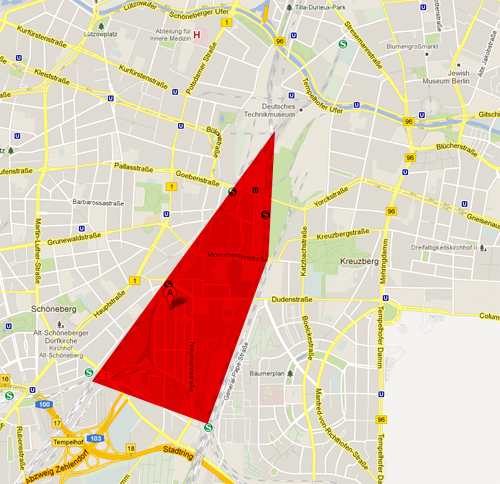
Die Rote Insel is called an island because it’s a triangular region surrounded by train tracks on all three sides, so one must cross a bridge to gain access. The ‘red’ part comes from the fact that it was historically a leftist stronghold and was allegedly the last part of Berlin to hold out against Hitler’s local political machine in the 30s.
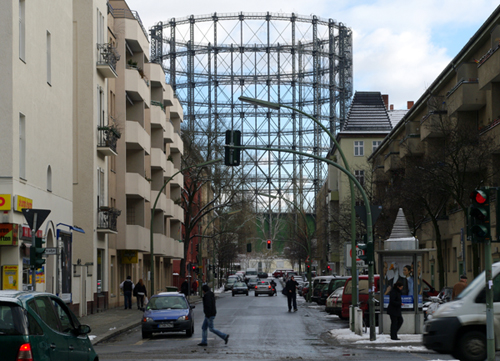
One local attraction is this weirdo gasworks structure that looms over the neighborhood:
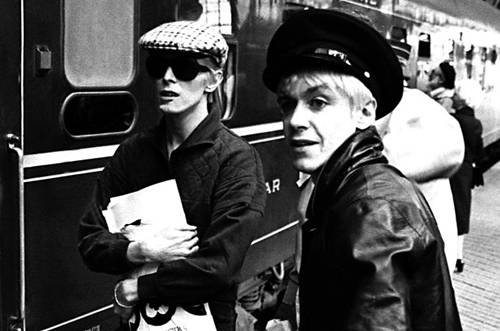
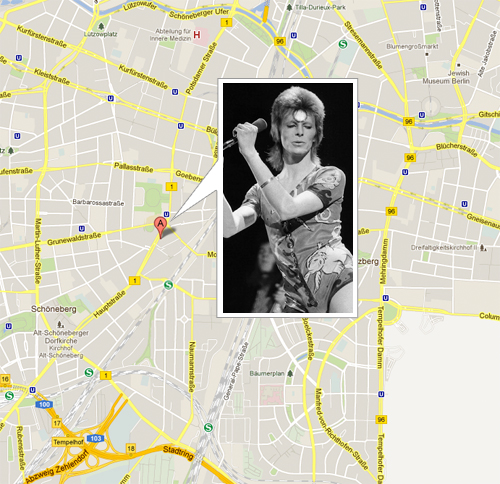
Another noteworthy thing is that we’re about half a mile from where David Bowie and Iggy Pop did their famous mid-70s sojourn:
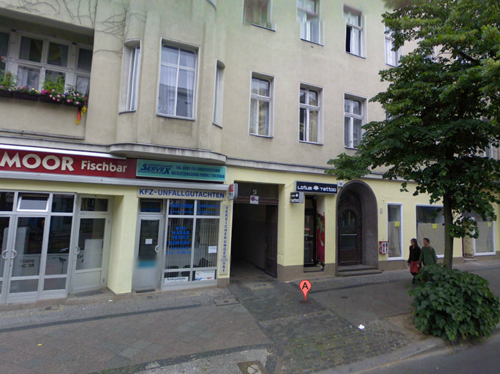
Here’s the oh-so-bland-and-unassuming building where they lived:
What this all is getting to is a meditation on the weird east-versus-west dynamics that persist in Berlin as a result of the Wall. As part of the former West Berlin, Schöneberg is now considered to be a bit of a snooze— friends of ours who live in hipper areas would assume slightly restrained expressions when we would mention that we were moving there (sort of like if you were to mention that you are moving to the Inner Richmond). And, yet, back when Bowie lived here, it was pretty much as swinging as West Berlin got. You had Kreuzberg to one side, which was slummy and punk and Turkish, and then Schöneberg, which was the gay district. I had originally guessed that the neighborhood’s gay identity stemmed from its relatively close proximity to the Wall— as such, I imagined that it was a kind of untamed borderlands where anything went. But, I’ve since learned that gay affiliation stretches all the way back to the Weimar Republic-era… so, never mind about that.
So, that’s the weird contradiction of Schöneberg: a relatively risqué, eastern area of a larger, boring western area. Seemed edgy at the time… but is looked down upon by all the hipsters in the former East. On the one hand, this all seems unique to Berlin and its particular dynamics. And yet… it also reminds you of Noe Valley if you squint your eyes. In fact, it’s really easy to imagine a similar partition in San Francisco, given the exaggerated east-west divide and the cultural disdain with which people in the neighborhoods to the North and East view the western part of the city.
As a reminder, here’s how it worked in Berlin:
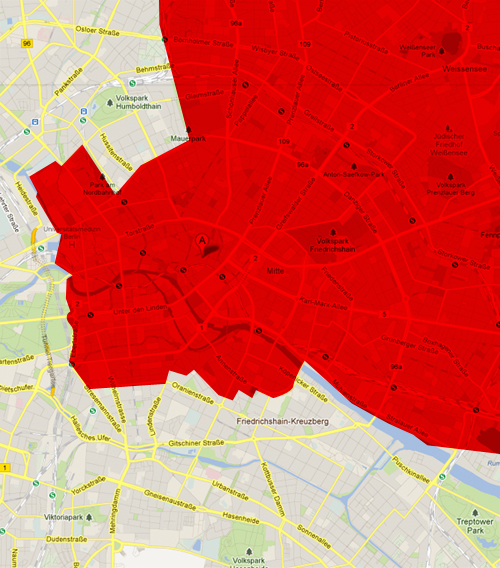
In my imaginary history, here’s how San Francisco was partitioned in 2005, dividing the MGDR (Matt Gonzalez Democratic Republic) from the secessionist RGN (Republic of Gavin Newsom) and tearing apart countless families and community institutions in the process:
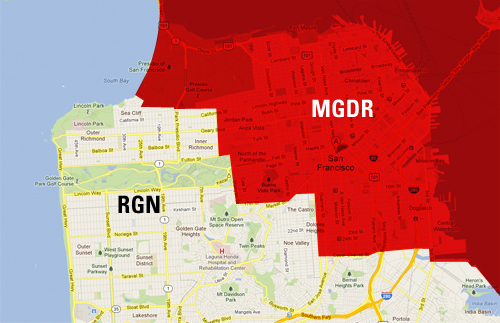
As a virtual island in hostile territory, the RGN is naturally cut off from bridge access and can only be accessed by plane, helicopter or hydrofoil. The West gets the Golden Gate Park, just as West Berlin got the Tierpark… but the East gets the heavily-armed Presidio (i.e., Mauerpark).
And, in the analogy, Schöneberg is roughly outer Noe Valley, which sounds… about right!
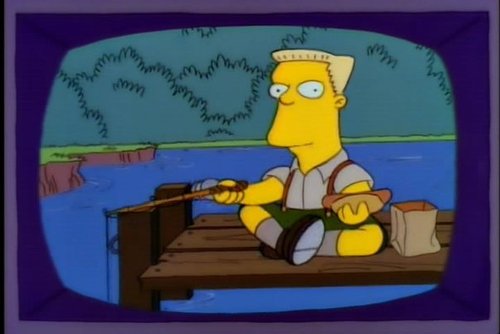
JohnnyO once discussed his ‘Wheels On The Bus’ iphone app that allows the user (his daughter, in his case) to play back the song in a number of different languages. All is good until you get to the German version, where the singer is breathlessly rushing to keep up with the music— such is the syllabic elephantiasis of the language that ‘Wheels On The Bus’ doesn’t fit into the allotted space.
I think of this story every time I toggle between the English and German versions of Craigslist Berlin. Seriously, the German version has the exact same content and is a third wider:
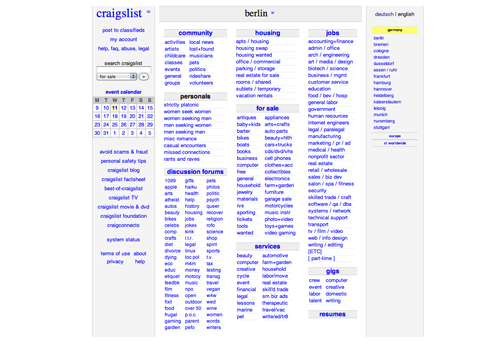
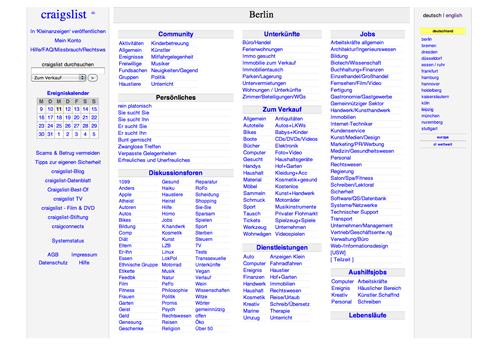
Just imagine if they started a section for the services of Eisenbahnknotenpunkthinundherschieber (railroad switchmen). That could push the total page width beyond 1200 pixels.
I have yet to actually do any significant design work in German language. But Czech language never failed to foil me with its diacritics (the little hats and angles worn by various letters). First of all, many fonts don’t include the characters; also, you can’t tightly pack lines of text vertically, because the stupid special characters bump into the letters above them. And, to my dismay, I quickly learned that you can’t just kinda sorta maybe get away with leaving out the accent— it would be like substituting in an entirely different letter. I’m sure that German will present its own share of bedeviling lines-that-don’t-wrap-because-one-word-is-too-long and dual English/German language layouts where the two text blocks aren’t remotely the same length. Until my proposal for a glorious Simplified International English language takes hold and renders other languages obsolete, that is. Details to follow…
See also: Mysteries of Czech Language
Sadly, my uncle lost his wife to cancer a few years ago, after something like 45 years of marriage. Since then, he’s had the good fortune to meet a new woman who now seems to be a permanent and supportive fixture in his life. But, what’s weird is that this new girlfriend was also once my father’s girlfriend… roughly 60 years ago. Yes, my dad’s very first girlfriend, at overnight camp in the early 1950s. They took canoe rides together and stuff like this. (Note: this is my uncle on my mom’s side— not my dad’s brother). Is a person really the same person they are involved in experiences that are separated by this much time?
Sometimes, I get the feeling that there were only about 20,000 people in the US when my parents were growing up. It just seems that everybody who belongs to a certain segment— say, grew up liberal and educated with some at-least-tenuous connection the East Coast— knows everybody else. I don’t get it.