Total Quality Management

Felix turned six months old on Friday. As it fell on a Friday, I allowed the family a rare dress-down casual day and we celebrated with some local hemp microbrews in the conference room.

As I’ve written about many times before, I strongly believe in raising a family according to the same principles that you would use to build a successful corporation. With this in mind, it this seemed like an appropriate time to give Felix his first performance review to make sure we’re all on the same page moving forward. I’m happy to report that he met or surpassed nearly all of his expectations for Q3 and Q4 of 2009. Overall, his high performance scores indicate that he’ll be a valuable member of our “team” in the coming years. I did, however, lay out a few “growth areas” for him to work on over the next two quarters, especially regarding his erratic and sometimes tardy attendance record for our Monday morning staff meetings. I’m confident that he will be able to address these points in time for his next review.

(Sample performance review for a previous employee, no longer with the family)

My wife refused to participate in the review process, saying something about how it’s “wrong to treat a 6 month old child like an employee.” Whatever. I guess I shouldn’t be surprised given the occasional skepticism she’s voiced in the past about my family-as-corporation analogy. I can understand her perspective to a point, but it does disappoint me that Felix didn’t get the benefit of a full “360 degree performance review” so favored by today’s top management consultants.

Even the most vigilant bureaucracy must sometimes heed the call of nature

And on that note, we’re off to the countryside for the weekend. Have a good one.

Fleetwood Mock

I should probably keep this to myself, but I’ve spent the last week avidly listening to Tusk by Fleetwood Mac, a band I’d never bothered to form an opinion about before. If you’re one of the zillions of people who grew up on Rumors, the notion of a guy in his mid-30s only just now catching up on Fleetwood Mac probably seems awkward at best. If you’re part of the equally large group that thinks the band is irredeemably cheesy, then my sudden devotion probably seems all the more heedless and shameful for being so late-to-the-ball. It guess it would be something like writing “I just found about this cultural phenomenon called ‘Burning Man’– I’m thinking about going next year!”– acotlytes and detractors alike would be nauseated, and nobody has a neutral attitude towards it. My only excuse is that I was a teenager in the late 80s in the Northeast: if there was ever a time and place hostile to late 70s smooth rock, that was it. So this genre became a sort of lingering blind spot for me, something I’ve only just caught up on in my 30s.

Anyway, I listened to Rumors a few times and it enjoyed it in the half-sincere/half-snide fashion that crops up over and over again in this blog (I’m probably going to have to add ‘things I’m not sure if I seriously or ironically enjoy’ to the tag list, but can’t figure out how to concisely phrase it). But then I moved on to Tusk, which is a legitimately great album– it has all the good things that Rumors has, but without the cloying-and-craning-for-stardom-and-success thing that makes Rumors a little bit annoying after a while. Believe me, I understand the dynamics that keep people from taking this band seriously: the multiple lineups, revolving front men, tacky intra-band romances and name formed from last names of band members— all of this seems a piece with the coke-fuelled arena-rocking supergroup zeitgeist of the late 70s. Then there’s whole cheesy/breezy LA thing (a Pitchfork staff list of best albums of the 1970s aptly likens Rumors to ‘a David Lynch LA’ with its ‘bowling lane-slick production’) and the Jefferson Starship-like 80s solo projects. There’s the Clintons and Gores prancing around victoriously to ‘Don’t Stop’ in ’94.

But once you peel aside all that compromising context, I don’t see why Tusk shouldn’t be a record that ‘serious’ music people listen to any less than, say, Big Star’s Sister Lovers: both are fractured, introspective, sprawling records by bands with brilliant songwriters, commercial aspirations and self-destructive trajectories, caught at a point when they had nothing to prove– albeit for opposite reasons. More than anything else, the difference between the records is Fleetwood Mac was coming off the highest-selling album in history, whereas Big Star had nothing to prove because they had no hope of stardom any more. Big Star never ‘made it’, and seem untainted partly as a result. With Fleetwood, we have to deal with all the grotesque flab of their successes, which is daunting indeed (I’m thinking specifically of Clinton’s big bobbing head here).

Another difference is that Big Star was never impersonated by a decoy band, a fate that befell Fleetwood Mac in one of the weirder episodes in rock promotion history. The band’s manager, Clifford Davis, frustrated by the band’s reluctance to tour, ridiculously claimed the legal rights to the band name and put together an imposter version of the band, then booked a series of concert dates and launched a U.S. tour. What? File this under Ruses That Wouldn’t Worked Out Nearly As Well In The Twitter Era. Given that this was the 1970s, word gradually began to leak out that the original members weren’t involved. I guess the fact that no women were involved in the lineup might have helped tip off audiences. Inevitably, the scam stalled as the real band members managed to get off their asses long enough to obtain a legal injunction against the rogue manager. Thus, the end of Fleetwood Mock.

Weirder still, the zombie Fleetwood Mac band– under new name Stretch– later released a hit single ‘Why Did You Do It? that’s actually good! Better yet, the song airs their grievances with real Fleetwood Mac drummer and namesake Mick Fleetwood (they had basically been sold the same bill of goods as the concert goers and expected that Mick was actually going to join them and legitimatize the project– whether Mick was complicit or not in the whole situation remains unclear and fiercely disputed). It’s a stolen identity grudge song! If you read the bio of fake Fleetwood guys, you’d never imagine that they’d be capable of going on to be a modest success in their own right–  judging from the names of the bands they were recruited from– Status Quo, Elmer Gantry’s Velvet Opera, Curved Air (!) it sounds like it’s gonna be the worst group in the history of the world. I’d known ‘Why Did You Do It?’ for years since my friend Sara put it on a mix for me and liked it OK without having any idea of the wacko history behind it.

Last thing, unrelated to above tangent: another convoluted chapter of the band’s history involves the hapless misfortunes of earlier frontman, Peter Green, who led the group a few incarnations before Buckingham and Nicks joined. Just for fun, if you unquestioningly accept the most sensationalistic version of each event reported on the internet, the story you wind up with is: Green’s mental health began to deteriorate after he unwittingly took acid in Munich, where he was hanging out at something called the ‘High-Fish-Community’ at the behest of two German promoters who wanted to stage a ‘Bavarian Woodstock’ (I can’t even type those last two words without giggling). As his sanity started to slip away, he insisted that the band members give all their money away to charity and quit once they refused, eventually joining the religious cult Children of God. This is the same outfit that Christopher Owens– front man of current indie darlings Girls– was born into and escaped from as a teenager. So: weird that there’s just one degree of separation (albeit a highly disturbing and un-fun one) separating Fleetwood Mac and Girls.

————-

Krafty adds: I suffered from the same “70s smooth rock blindspot” as Dan, and never truly appreciated FM until I saw this amazing documentary about the making of “Rumors.” It’s part of VH1’s “Classic Albums” series, where the filmmaker interviews band members, producers, and other people involved with the record, and there are always extended scenes in the studio where the master tracks are getting messed around with (so you get to hear the song with just the drums, then with the drums and bass, then with the backing vocals, etc.). I cannot recommend the “Rumors” installment highly enough: everybody in it (particularly Lindsey Buckingham) is amazingly articulate in describing what it was like to be the most popular band in the world, on lots of drugs, and also two couples in the process of breaking up and writing songs about the disintegration of the relationships that would become the most successful album in the world. If you set your Tivo to “Classic Albums,” it will record it within about six weeks (I’ve discovered this through erasing it by mistake periodically and the re-recording it).

El Pato Falso

This is my publicly-accessible business registry information as retrieved from the web site of the Czech Statistical Office. The line I’ve highlighted in yellow shows my previous address in U.S. Everything’s okay through street, street number, city… until you get to ‘Spojené státy mexické,’ which is ‘United States of Mexico’. ¿ Um… que ? That’s right: according to the Czech Statistical Office, I’m Mexican. I guess the person entering my info saw the ‘San Francisco’ part and felt confident completing the rest of the entry on the basis of logical association.

This is exactly the sort of situation where I ought to get busy leaping headlong into the pool of Czech bureaucratic magical realism to resolve the error this right away but instead will summarily ignore until it jumps up to bite me in the ass at some key moment (‘Señor Mayer, we cannot remove your appendix until this discrepancy about your home country is resolved‘). On the other hand, maybe it’s better that I at least wait until I’m done with the design project for the Czech Burritos– that would be a suspicious contradiction to try and explain away to the authorities. I guess one humorous silver lining to the whole situation is that my son is now officially ‘Czech-Mex’, according to the powers that be.

Assorted thoughts on Buy Nothing Day

  • Yesterday was a nice occasion to stop and reflect on all the things we’re grateful for in life. Unfortunately, it was also the nine year anniversary of Katherine Harris certifying George W. Bush as the winner of Florida’s electoral votes. Well, isn’t that a kick in the teeth. Happy ‘Angst-giving’.
  • Having a spiral staircase in your apartment seems like a really cool perk until you sprain your ankle playing basketball and are hobbling around on crutches. Then: not so perky. I know I mentioned this feature of our flat as a hazard to our kiddo already in the Obecni Dum post, but hurting my ankle really brings the point home. Every time I need to go upstairs to get something, I feel like I should have a team of sherpas with me.
  • I had plans for a classic food-laden, rowdy Thanksgiving with fellow expats, but wound up getting snowed in the entire day by a combination of bum ankle and rush project for work. Not the most festive of holidays. Sitting marooned in my arm chair, I got so hungry at one point that my infant son started to metamorphosize into a plump turkey before my eyes…
  • Finally, if you’re a designer and reading this, you must read this glorious email flame war between designer and client. There’s nothing quite like mocking a would-be client through libelous pie charts (hat tip: reader KF).

More from 'The Book'

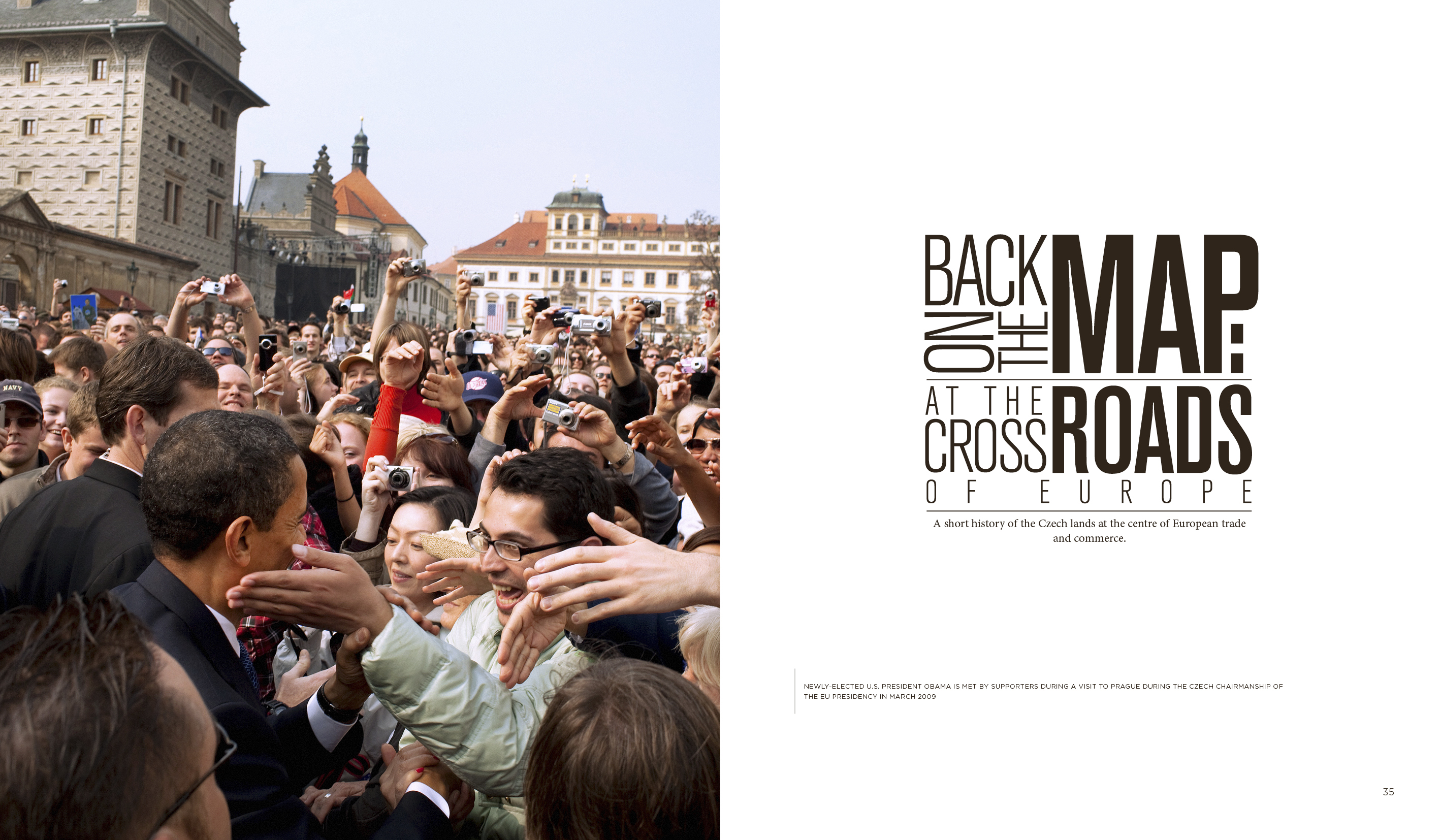
Another batch of spreads below from my just-finished mammoth book project. Previous installment yesterday.

Classic production crisis story: our writer walked away halfway through the project (justifiably, given that the book mushroomed from 120 originally-planned pages to three times that), leaving me and the managing editor, Tom, to cobble together the rest of the copy in a manner that resembled two guys running around a field with flaming beehives on their heads. Also, we were the only native English-speakers on hand to proof it. During the last frantic production push, I spotted a reference to the town ‘Cerhovice’ in western Bohemia on one of the dozen or so maps included in the book. Stupidly, I somehow convinced myself that it’s supposed to be Čerhovice, which sounds more correct to me in Czech (the accent changes the pronunciation to a ‘Ch’ sound). Normally, I would cautiously triple-check any foray into Czech diacritics, but in this case– no doubt due to overall project fatigue– I somehow convinced myself that the ‘Č’ spelling is right, barged ahead and changed it.

Fast-forward to two days later: we’ve sent the final files off the printer and I’m sitting in the car– a quivering mass of frayed nerves– heading towards Austrian Alps R&R with my family. Suddenly, on a highway sign, I spot ‘Cerhovice’. With no little hat accent over the C. Abject panic. I phone the office and reach our production lady who nonchalantly informs me ‘Oh, we caught that last night. Enjoy your vacation.’

(Click on any thumbnail for larger image. All images copyright 2009 Dept. of Design.)

Done

The first copies of the CTP Yearbook (the project I’ve been ominously referring to as ‘The Book’ in this blog) came back from the printer on Friday night. This is the 360+ page book that I’ve been working on since April for an industrial developer and wound up designing every last millimeter of. For perspective’s sake, I’ve been working on the book since before my son was born and since before I started this blog. My two immediate reactions to seeing the printed version (above) is ‘Jesus, it looks like a phone book!’ and ‘Wow, the paper we chose really helps’– we used a heavy kind of rough paper which makes the colors look dark and saturated and helps fend off any unwanted cheesy corporate sheen.

I wanted to show photos of the actual physical book, but the intensely bright lamp we use here for product shots literally caught on fire a few minutes after I turned it on (at least, a horrifyingly noxious smoke started rising from it). Also, the book is so big that it’s almost impossible to pull open in a way where you can get a nice even shot, unless you have several minions helping you to tug it open. So, these are from the digital files we sent off to the printer instead….

(Click on any thumbnail for larger image. All images copyright 2009 Dept. of Design.)

I’ll post another batch of spreads tomorrow.

Unsettling info graphics of the day

Patent diagrams by Donald Spector from 1988 and 1999 respectively:

The top one is for an inflatable doll that expands when taken out of its test tube. The bottom one is for something called the Mommy Box that provided a ‘soothing’ video link to mother for distressed babies. These diagrams make a lot more sense in context, of course, but with all the mimicry going on (baby <> doll, real mom <> video mom), it’s not surprising that the initial effect is highly disconcerting.

(Via Thingamababy).

More bogus/silly info graphics here. More on unintended consequences of creepy robot doubling here.

Mad Men and Doyle Dane Bernbach

Believe it or not, I’ve just started watching Mad Men. I’m all the way back at Season 1, Episode 4– so far behind that I can read TK’s posts on the current episodes without spoiling anything for myself as the plot has moved on to completely alien terrain from what I’m familiar with.

I was delighted to see Episode 3 open with Don Draper looking at the Volkswagen ‘Think Small’ ad— a campaign that changed advertising to the degree that I show it to my graphic design history students— and thought that the campaign was cleverly used in the episode to amplify some of the larger points of the show. I should hedge this last comment by saying that I haven’t really seen enough of the show to weigh in authoritatively yet on what the larger themes of the show actually are, but so far I take it as a snapshot of the last days of trying to have a top-down, hierarchical society in America before pluralism stepped in and turned everything on its head. If you accept that as an underlying theme of Mad Men, you can definitely say that the appearance of Doyle Dane Bernbach– the agency behind the VW campaign– marked a tipping point in the real-life narrative.

Doyle Dane Bernbach opened its doors in 1949 and became known for its determination to ‘take the exclamation point out of advertising’– meaning, among other things, less nuptial script, grinning Stepford wives and long-winded copy stuffed full with promises (1940s ads were really, really long on copy). By the early 1960s, removing the exclamation point had become imperative: the murmurs of a civil rights movement and engagement in Vietnam increased the public’s appetite for real reportage and decreased its tolerance for Eisenhower-era fluff. TV revenues, meanwhile, had cut into magazine revenues to the point that budgets and physical formats were smaller, meaning the exclamation points couldn’t ever be as large or glamorous again as they had been in the past. Finally, I imagine that TV, by the nature of its very medium, probably inspired a move towards intelligent advertising: in print, you can keep making the same corny over-promises over and over again and never get called on it. But, in the world of TV, you have to have an actual live person making these claims (‘gum that cleans and straightens your teeth!’). I’m guessing that the humiliation gleaned from this experience- for all parties involved- partly inspired a move towards more intelligent advertising on some psychological level.

DDB was the first agency of note to try selling stuff by leveling with the audience and appealing to its intelligence. The ‘Think Small’ ad spoke directly to a potential product liability and used a white space in a surprising way to stand apart from the crowd:

Subsequent ads in the campaign– which I just noticed was voted best of the century by something called AdAge.com– included the car with a caption ‘Lemon’:

… and a play on the homeliness of the lunar module:

I loved the verdict delivered in the Mad Men episode, where all the characters basically dump on it (‘They only used a half-page ad for a full-page buy… you can’t even see the product!’) but then Draper points out, ‘Love it or hate it, we’ve been talking about it now for 20 minutes’.

The corporate structure in Mad Men was also typical of most ad agencies of the day: as is shown several times in the first few episodes, account execs and writers develop the concept, then hand it off to the art department which is responsible for bringing it to life without any creative input. Again: top-down, hierarchical. DDB pioneered what became known as the ‘creative revolution’, where project teams including an art director and writer would brainstorm together to develop the idea, effectively forcing a synergistic relationship between word and image.

My favorite DDB campaign is one they did for Levy’s, an account they had held for several years without highlighting the ethnic angle until this poster appeared in subways in 1961:

Update: for serious type nerds, reader MM passes on this typo analysis of Mad Men from Mark Simonson’s blog.

Czech Mex

A rejected directional sketch I did for our client who’s selling burritos in Prague:

czech_mex4

For such an indispensable and delicious foodstuff, the burrito sure is a difficult thing to make look good. It often winds up looking like an amorphous blob when illustrated and downright repulsive when photographed. There’s a real need in this project, moreover, to show it in a way that’s both appetizing and readily identifiable, as lots of central Europeans are somewhat fuzzy on the whole concept. We discovered that my fellow designer here at the studio, a Ukranian fellow, had no idea whatsoever what they’re about.

I kinda like this pseudo-woodcut look, but we collectively resolved to go in a more diagrammatic ‘Tech Mex’ direction, which is fine with me. I would happily sign the rights to this over to anyone who would overnight FedEx me a Mission burrito in exchange. All this burrito-related design work is making me really hungry.