
The Legs of Izolda Morgan

I’ve been working on another freelance book cover project for Twisted Spoon Press, this one another collection of writings by Bruno Jasienski. Jasienski was a leader of the Polish Futurism movement who was deported from France on the basis of his ‘catastophist’ novel I Burn Paris (which I also did a cover for, due out in the fall via Twisted Spoon), and wound up eventually perishing in the gulag of the U.S.S.R. after initially receiving a hero’s welcome there on his arrival.

The most celebrated story in this collection is ‘The Legs of Izolda Morgan’, a delirious tale about a worker who steals his girlfriend’s legs after she’s run over by a tram and sliced in two in the opening lines of the story. The worker basically flips out and decides that machines are out to get us, and strikes back by attempting to sabotage the factory he works in. As a characterization of someone whose sanity seems to have been tainted by contact with the machine age, ‘The Legs of Izolda Morgan’ isn’t exactly as sympathetic as you might expect to technology and modernity as you might expect coming from an avowed Futurist. The story is accompanied (and further obfuscated) by a weird little preface, Exposé, that contains lots of odd provocations and baffling statements, such as this passage that I’m thinking about using on the back cover:

I do not claim that the present book should stand as an example of how the contemporary novel ought to be written. But it is most certainly an example of how the novel cannot be written these days (the joke that you wish to make here, dear reader, only confirms your naivité).

Sometimes, Jasienski doesn’t seem so much a committed ideologue as just somebody who likes stirring up controversy and rattling chains, which I suppose puts him in good company with many other practitioners of Futurism, a movement that was basically founded by a brilliant and subversive clown.

Another story in the collection is called ‘The Nose’, which presents a tempting cover design opportunity in that the cover could be divided in two between nose and legs. However, as ‘Legs’ is the most celebrated story, I’ve inevitably come back around to letting this one be the star of the show. The publisher and I discussed using an all typographic cover, which sort of led me in the direction shown here that I’m currently leaning toward:
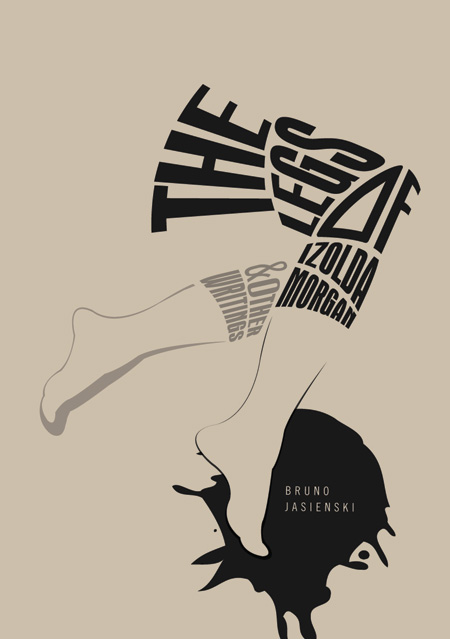
The idea would be to print this on a rough recycled paper, to get the same feeling as those great Bukowski publications from Black Sparrow Press. Still very much kicking this one around, though — a few things about it don’t entirely sit well with me. Mainly, it doesn’t  look ‘of its time period’ (e.g. 1930s), which is something I’ve made a conscious effort to achieve with my other Twisted Spoon covers. But maybe that’s a welcome change… ?

Weekend song: Let Her Dance / Don't Ever Let Me Know

I might be the only person who likes Bobby Fuller (best remembered as the guy who originally recorded ‘I Fought The Law‘) better than his obvious inspiration and fellow Texan Buddy Holly. This is kind of like saying you prefer the Monkees to the Beatles. Fuller has none of the depth and resonance of Holly (hell, Buddy Holly basically established the idea of rock ‘n’ roll recording artists writing their own material) and was fairly minor figure in comparison… but, for whatever reason, his better songs sound exactly how 50s rock songs should sound to my ears: simple, driving, all wound-up and kinetic (exactly the same qualities that the Ramones brought back into the picture).

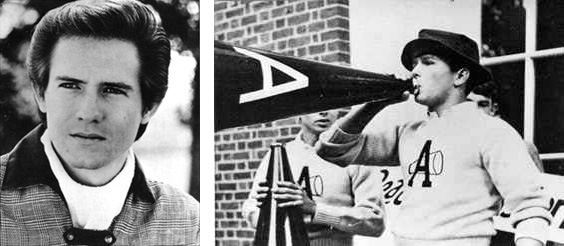
Really, the only thing that bothers me about Fuller is his occasional eerie resemblance to George W. Bush:

In terms of a song choice, ‘Let Her Dance’ doesn’t really constitute a sleeper, in the sense that it’s probably his third or fourth best known song. But, still, no one whom I talk about music with cares about this track, and it literally might be my favorite single example of 50s-style rock ‘n’ roll, so up it goes:

Let Her Dance — Bobby Fuller Four

Then, for something more sleeper-ish, it’s hard to resist ‘Don’t Ever Let Me Know’, the pretty B-side to the ‘I Fought The Law’ single:

Don’t Ever Let Me Know — Bobby Fuller Four

Designated 'Roid Guy

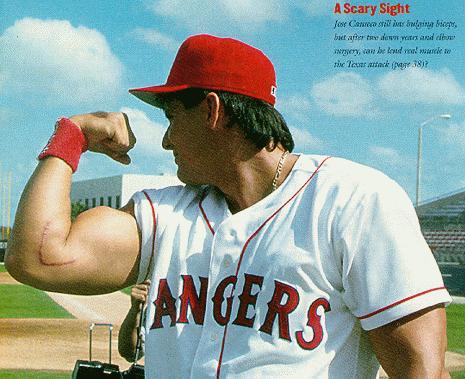
Everyone knows that Major League Baseball has hosed itself with its mismanagement of the steroid problem. Purists can no longer innocently compare players from different eras when the late ’90s and early ’00s were conspicuously full of wily middle infielders who suddenly showed up with 50 extra pounds of muscle, a plague of tics and 40-home-run power. Idealistic fans feel betrayed for having emotionally invested themselves in the doings of cheaters. What’s worse — but rarely discussed — is that the few fans who aren’t offended by what happened during the steroid era are bored by what’s happening now that the game’s been cleaned up. In Bill Simmons’ recent mailbag column on espn.com,  a reader named Mark from Baltimore sums it up perfectly:

So I was at an O’s versus Yanks game the other day and an Orioles rep was going around asking fans questions, and one of them asked me what I thought the O’s needed to do to improve this year. I said, “They need to get Miguel Tejada back on the steroids so he can blast 40 home runs like the good old days.” They did not think that was funny.

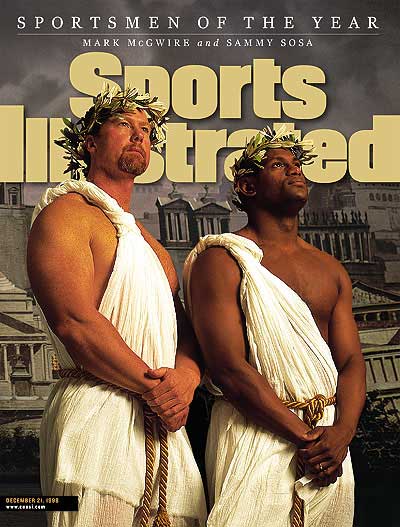
Baseball– let’s face it– is a fairly boring game, and (health issues aside) it’s clearly more entertaining to have guys doing steroids, blasting home runs, donning togas and lying to congress than not doing these things, especially if your team stinks.

My solution to this is to bring steroids back into the game, rather than trying futilely to sweep them under the rug as MLB has been pathetically attempting for the past few years. But you have to bring it back in a controlled way. So, each team should be allowed to have ONE guy do steroids. It’s the evolutionary descendant of the Designated Hitter– we already have the DH, now we’ll add the DRG (Designated ‘Roid Guy). This way the comical/enraged foibles of the steroid user will be reintroduced to the game, but in a contained way such that the culture of ‘roiding wouldn’t overrun the sport again.

As a bonus, imagine the strategic wrinkles that the DRG would add to the game. If you’re the Red Sox front office, for example, do you tag David Ortiz as your DRG (the obvious choice– hopefully, he suddenly recovers his 04-07 power)… or, do you take a chance on Adrian Beltre, who put up one of the most obviously steroid-inflated stat lines in 2004 (.629 SLG, 48 HR all in Dodger Stadium in what JUST HAPPENED to be a walk year before hitting free agency)? Moreover, let’s assume MLB screws up the implementation of the new rule and adds it to just one league and not the other, like they did with the DH. Suddenly, you’d have teams furiously ‘roiding up a guy and then de-‘roiding him in preparation for interleague play and the World Series. Finally, there would be the comedy of inept GMs making dumb choices and squandering the DRG rule. I can just imagine the Pittsburgh GM using the DRG tag on somebody like the diminutive David Eckstein and being all surprised when it doesn’t work.

Pitchfork's Top Albums of 1909

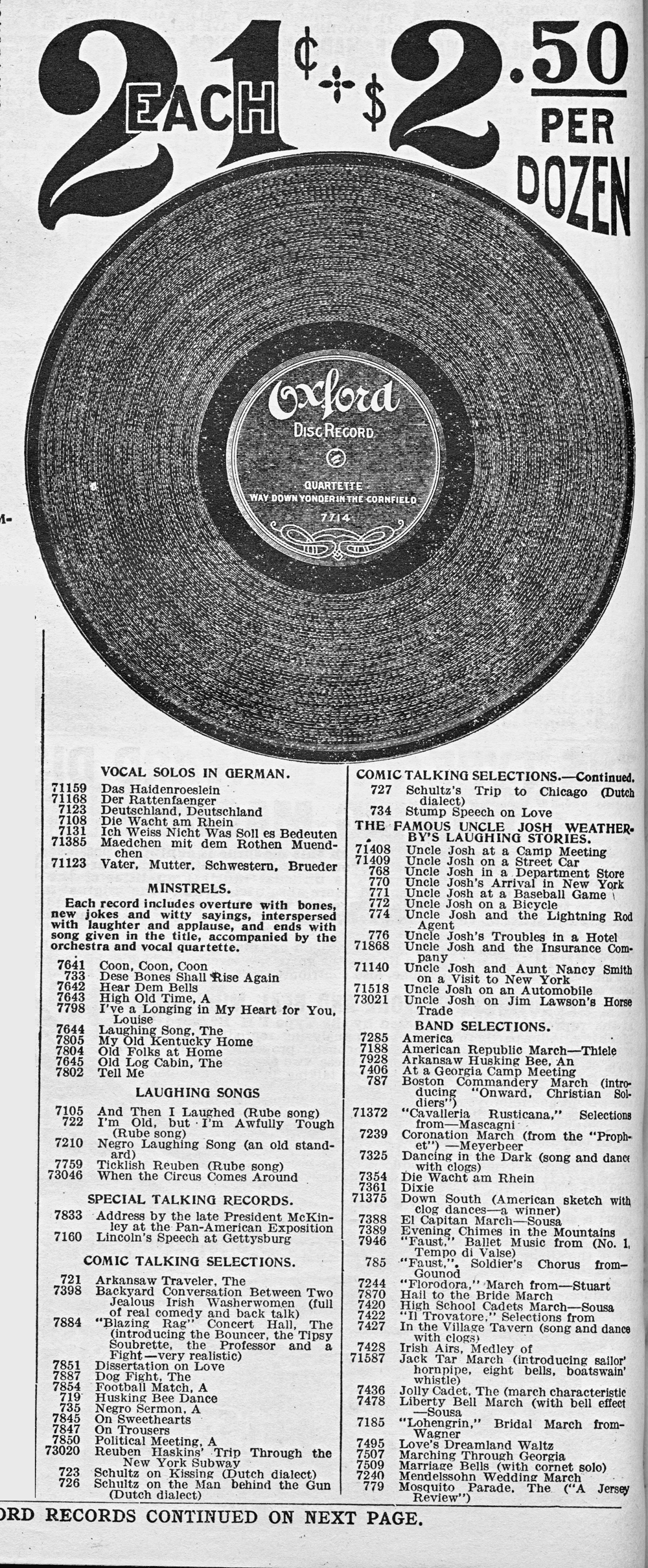
From my replica Sears Catalog from 1909, check out this bogglingly weird selection of records available for order (click picture for much larger image).

There’s a whole section of ‘Laughing Songs’, for example, including a little number called ‘And Then I Laughed’. If laughing stories are more up your alley than laughing songs, you’re in luck: there’s a wide selection of ‘The Famous Uncle Josh Weatherby’s Laughing Stories.”

Also contains: jarring racism. Interestingly, the Dutch get the brunt of this almost as much as blacks do.

For more fun with the replica Sears Catalog, check out the Harris 20th Century Railroad Attachment.

Friday song: Born In The Wrong Time

(This time on a Sunday, for no particular reason.)

When I was much younger, I used to assume that the existence of any album I liked was essentially predetermined, as though god had decided ‘Let there be Rocket To Russia’. As I got older, I began to realize that a lot of these records were subject to the vagaries of adult lives and adult flakiness. Maybe a record like Fleetwood Mac’s Rumors was bound to happen. But what about all the little fly-by-night bands that dot the history of music… what if the weather is bad and the drummer decides not to bother making the drive to the recording session? What if the 19 year-old guitarist gets in a fight with the 20 year-old bassist?

Consider this fraught back story: band forms in 1978; bassist quits shortly thereafter; band breaks up later in 1979; band reforms in 1980 with a new bassist. In 1981, band decides to do an album only to discover that the small number of sound engineers in their native New Zealand all uniformly dislike their sound. Band records two EPs and a single on a friend’s four track before breaking up again in 1982. In either ’82 or ’83, the band’s guitarist and drummer — two brothers — get together to produce a few home recordings which they release under the name The Great Unwashed, a joke on their original name The Clean. In 1984, the brothers put together a band to back the new material, which includes the original bassist, now playing guitar. This lineup releases a new EP of material called Singles before breaking up again later that year.

Somewhat surprising, then, that with all this breaking-up and getting-back-together and brothers moving back and forth between Christchurch, Auckland and Dunedin, the band’s fleeting side project produced a song with the kind of perfect craftsmanship of ‘Born In The Wrong Time’ (written and sung by the original bassist, Peter Gutteridge). Not even two and a half minutes long, it nevertheless manages to create a really striking and sobering mood around an imaginative choice of subject matter:

Born In The Wrong Time — The Great Unwashed

—–

Personal story regarding The Clean: In 1989, the ever-ambitious Krafty arranged for a then-unknown Galaxie 500 to play at our high school (footage here). Later that year, the Clean reformed to do a reunion tour. This seemed like the only chance we’d ever get to see our heroes, but the Clean were playing at a bar in Boston that was impossible to get into with a fake ID (thank you, Michael Dukakis). Luckily, the booking agent for the Clean show was the same guy who had booked the Galaxie show and ‘owed a favor’ to Krafty. So, we called him up and were told, “Sure, just show up to the sound check and we’ll work it out.” Well, when we came to show, the booking agent wound up telling the doormen that we were the road crew for the Clean. This still cracks me up: the idea that three strapping men from New Zealand in their late 20s would hire two scrawny teenagers — clearly from the Boston area —  to carry their gear around on tour… but, hey, whatever works.

By the way, while doing ‘research’ for this post, I wound up inadvertently googling people who feel that they’ve been born in the wrong time. Check out assorted metaphysical whimpering here, here and here. My favorite is the helpful respondent who suggest going to Renaissance Fairs in the last link as a therapeutic solution.

Auto-blather

Lately I’m getting more and more emails that contain a quick line of conciliatory auto-blather at the bottom like this:

Is this a new “thing”? (Yes, I’m squinting and making quote-mark signs in the air right now). What could possibly be the value in this? Imagine extending this same convention to spoken conversation:

“Hey, I’m ordering food– you guys want anything? Please do not hesitate to ask me if there are any questions or queries regarding the preceding question.”

“No, Dan– we’re fine.”

“Alright, back in a few minutes then. Please do not hesitate to ask me if there are–”

“NO… FINE… UNDERSTOOD.”

America's Game

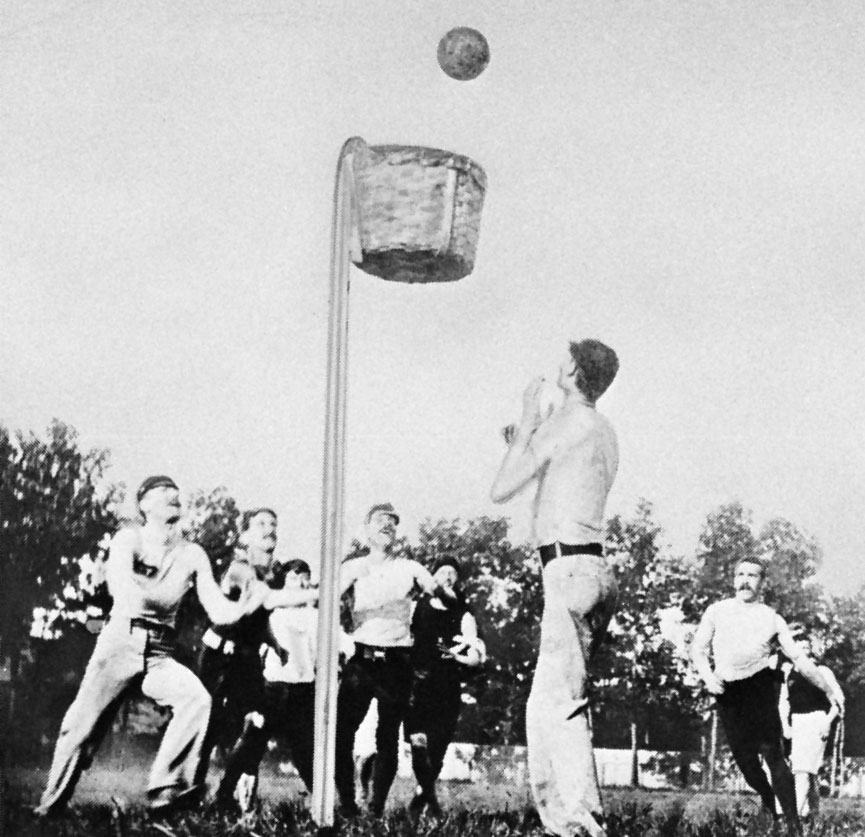
I’m deeply enjoying the 2010 NBA playoffs these days, and have noticed that most of the Czech guys who I play basketball with every Tuesday have a meticulous knowledge of NBA players and teams. This is interesting when you think about the fact that basketball is the only truly American game, having been invented by a Phys-Ed teacher in Springfield, MA in 1891. Compare this to baseball, a game touted as “America’s Game” that draws on European games for its rules and boasts of a “World Series” that Czechs wouldn’t be caught dead watching. (You can catch NBA playoff games on TV in specialty sports bars in Prague, and NFL is also a mainstay. Hockey, meanwhile, is considerably more popular here than it is in the U.S., probably on par with Canadian enthusiasm. Baseball, on the other hand, is an absolute blackout: no World Series, no nothing).

The speed with which the Peach Basket Game gained popularity is always striking to me, but never more so than when I show my design students a movie called The Man With A Movie Camera, an 1929 avant-garde piece of Soviet film by Dziga Vertov that captures everyday events in an aggressively abstract and non-linear manner. There’s an artsy montage of people playing sports where you see a group of Russian women engaged in some incredibly dated- and weird-looking athletic activity that you suddenly realize — wow! — is basketball. The story of how basketball permeated this nascent cultural iron curtain in the first 38 years of its existence is a job for another blog far less lazy than this one, but let’s just say it surprises me a little every time I see the film.

(Blurry Soviet female basketball scrum from The Man With A Movie Camera)

So, while I acknowledge that the sport has achieved great heights, I have a few suggestions and scenarios that I think would add interesting wrinkles:

  • Halloween pageants where teams dress up in the spirit of their team name. How much better would, say, a random Utah / San Antonio game be if involved a cultural showdown where ‘jazzmen’ maneuver against cowboys clanking around in spurs and full regalia?
  • The option to suddenly punt the basketball through upright goal posts positioned 10 yards behind the basket for 3 points
  • My plan to dress NBA coaches in players’ uniforms, following the example of baseball (further discussed here)
  • Port-a-potties positioned along the court. This came to mind when I thought about the fact that no one ever has to pee during our hour and half Tuesday pick-up games. Obviously, the reason is that we’re all running like antelopes and sweating out all the water in our bodies. But what if athletic activity massively increased – rather than decreased – the need to go? Imagine the drama and ensuing recrimination as certain players desperately peel off for ‘pit stops’ during key moments in the action, as in a marathon
  • Something involving leg warmers, berets and mimes that I haven’t fully worked out yet.

Czech product marketing update

My father was visiting last week. It took his discerning eye to draw our attention to the name of our current toilet paper brand, which I hadn’t noticed before:

Happyend, a German brand. No word yet on the specific terms of this guarantee.

Meanwhile, Mr. Clean has become Mr. Proper:

Same guy, but over here his fastidious nature extends to moral issues as well.

For more fun in this vein, see Sick/Barf.

Friday song: The Clown

Around the time that Charles Mingus was having his psychologist write the liner notes for his albums, he released The Clown, whose title track centers around a made-up-on-the-fly story narrated by Jean Shepherd (the same guy responsible for A Christmas Story). Musicians are forever bitching about how their listeners don’t really ‘get’ them, but Mingus is the only guy I can think of to creatively channel this resentment– in this case, into a story about a clown (‘a real happy guy’) who martyrs himself to the cruel appetites of his audience:

The Clown’ by Charles Mingus

I saw a documentary about Mingus once where they related an anecdote about a time that his band was playing in a San Francisco bar. Mingus, a notorious rage-o-holic, got pissed off because the audience kept chattering and not paying attention to the band, so he eventually proposed that the band and audience ‘trade fours’: they would play for four bars, then stop so the audience could talk for four bars. Of course, the audience got ate this up and got really into it– which is I suppose a tiny real life analogy to the storyline of ‘The Clown’.